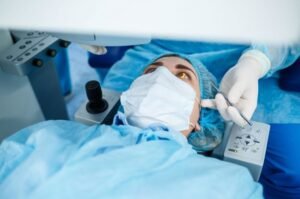

You’ve decided you’re done with glasses and contacts. You’ve started researching your options and two procedures keep coming up: LASIK vs ICL. Both promise clear vision without the daily hassle of corrective lenses, both are performed by ophthalmologists, and both have excellent track records. So how do you choose between them?
The honest answer is that LASIK and ICL are not competing procedures — they’re complementary ones. Each is designed for a different type of patient, a different range of prescriptions, and a different set of eye characteristics. Choosing the right one isn’t about which is “better” in some abstract sense. It’s about which is better for your specific eyes, your specific prescription, and your specific lifestyle.
In this guide, we’ll break down exactly how each procedure works, who it’s best suited for, how they compare on every factor that matters — from recovery time to long-term results — and how to figure out which one is the right path for you.
How LASIK Works: Reshaping the Cornea
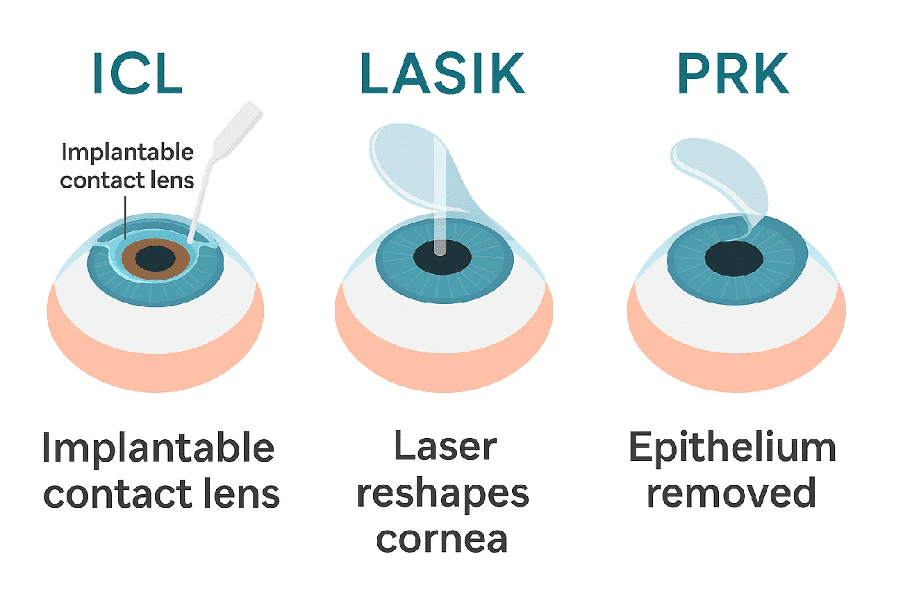
LASIK, which stands for Laser-Assisted In Situ Keratomileusis, works by permanently reshaping the cornea — the clear front surface of your eye. The cornea is responsible for about two-thirds of your eye’s focusing power, so even small changes to its curvature can dramatically alter how light enters the eye and hits the retina.
During the procedure, your surgeon uses a femtosecond laser to create a thin, circular flap in the outer layer of the cornea. This flap is gently lifted to expose the underlying corneal tissue. A second laser, called an excimer laser, then removes microscopic amounts of tissue to reshape the cornea according to a precise map of your eye. If you’re short-sighted, the cornea is flattened slightly. If you’re long-sighted, it’s made steeper. If you have astigmatism, the uneven curvature is smoothed out.
The entire process takes about ten to fifteen minutes for both eyes. The flap is repositioned and begins healing almost immediately without stitches. Most patients notice dramatically improved vision within hours, and by the next morning, the world looks different.
LASIK has been performed for over twenty-five years and is one of the most studied elective procedures in medical history. The technology has improved enormously since its early days, and modern femtosecond LASIK with wavefront-guided treatment profiles delivers remarkably precise, predictable results.
How ICL Works: Adding a Lens Inside the Eye
ICL stands for Implantable Collamer Lens, sometimes also referred to as an implantable contact lens — though that name is slightly misleading because unlike a regular contact lens, an ICL is placed inside the eye and never needs to be removed, cleaned, or maintained.
The procedure involves making a tiny incision — typically around three millimetres — at the edge of the cornea. Through this micro-incision, your surgeon inserts a soft, foldable lens made from Collamer, a biocompatible material that contains collagen. The lens unfolds inside the eye and is positioned in the posterior chamber, which is the space between the iris and your natural crystalline lens. It sits there permanently, working in harmony with your natural lens to focus light correctly onto the retina.
The entire procedure takes about twenty to thirty minutes for both eyes, with each eye typically done in the same session or on consecutive days. Because the incision is so small, it self-seals without stitches. Most patients notice a significant improvement in vision immediately, with full results stabilising over the following few days.
The ICL procedure has been performed for over twenty years and uses the STAAR Visian ICL, which is the most widely implanted lens of its kind globally with over two million lenses implanted worldwide.
The Fundamental Difference: Tissue Removal vs Tissue Addition
This is the most important conceptual difference between the two procedures, and it influences almost everything else.
LASIK works by subtraction. It removes corneal tissue to change the eye’s focusing power. Once that tissue is removed, it cannot be put back. The procedure is permanent and irreversible in the traditional sense — though enhancement procedures can be performed if needed.
ICL works by addition. It places a new optical element inside the eye without removing or altering any existing tissue. Your cornea remains completely untouched, and your natural lens stays in place. And because nothing is removed, the procedure is fully reversible. If your prescription changes dramatically, if a better technology emerges in the future, or if you ever need the lens removed for any reason, it can be taken out and your eye returns to its original state.
This distinction matters enormously, and it’s the foundation upon which the clinical decision between LASIK and ICL is made.
Prescription Range: Where Each Procedure Excels
This is often the deciding factor. LASIK and ICL cover different prescription ranges, and there’s a sweet spot for each.
LASIK is most effective and safest for mild to moderate prescriptions. For myopia, most surgeons are comfortable treating up to around minus six to minus eight dioptres with LASIK, though some will treat up to minus ten in patients with sufficiently thick corneas. For hyperopia, the effective range is generally up to plus four dioptres. Astigmatism can be corrected up to about five or six dioptres.
The reason there’s a limit is physics. The higher your prescription, the more corneal tissue needs to be removed. Every cornea has a minimum safe thickness that must be preserved to maintain structural integrity. If your prescription is very high, there simply isn’t enough tissue to remove without compromising the cornea’s strength, which could lead to a condition called ectasia — a dangerous thinning and bulging of the cornea.
ICL, on the other hand, thrives at higher prescriptions. It can correct myopia from minus three all the way up to minus twenty dioptres, and astigmatism up to six dioptres. Because ICL doesn’t touch the cornea at all, the thickness of your cornea is irrelevant to the correction. Whether you’re minus eight or minus eighteen, the ICL provides the same quality of optical correction.
This means that for patients with prescriptions between minus three and minus six, both LASIK and ICL are viable options. Below minus three, LASIK is usually the simpler and more cost-effective choice. Above minus eight, ICL is almost always the recommended procedure.
Corneal Thickness: Why It Can Rule Out LASIK
Your corneal thickness is one of the most critical measurements in determining LASIK candidacy. The average human cornea is about 540 to 550 microns thick. LASIK requires a certain amount of tissue to create the flap and perform the reshaping, and a safe residual bed thickness of at least 250 to 300 microns must be maintained after surgery.
If your corneas are on the thinner side — say 480 to 510 microns — and your prescription is moderate to high, there may simply not be enough tissue to work with safely. In these cases, LASIK would be ruled out even if your prescription is technically within the treatable range.
This is where ICL becomes not just an alternative but genuinely the superior option. Because ICL leaves the cornea completely intact, thin corneas are no barrier whatsoever. In fact, many ICL patients were originally LASIK candidates who were declined due to insufficient corneal thickness. For these patients, ICL isn’t a consolation prize — it’s often the better procedure, delivering sharper optical quality without any compromise to corneal structure.
During your pre-operative assessment, your corneal thickness is measured precisely using a device called a pachymeter, and your corneal shape is mapped in detail using Pentacam topography. These measurements, combined with your prescription, determine whether LASIK, ICL, or both are safe options for you.
Visual Quality: The Optics Argument
This is something that doesn’t get discussed enough, and it’s a point worth understanding.
LASIK achieves excellent visual results for the majority of patients. However, because it works by reshaping the cornea — which is a curved surface — the optical quality of the correction can vary slightly depending on the amount of tissue removed. Higher corrections require more tissue removal, which can introduce subtle optical effects called higher-order aberrations. These might manifest as mild starbursting or halos around lights at night, particularly in patients with large pupils.
Modern wavefront-guided LASIK has significantly reduced these effects compared to older techniques, and most patients experience minimal or no night vision symptoms. But the general principle remains: the higher the correction with LASIK, the greater the potential for these subtle optical effects.
ICL takes a fundamentally different optical approach. The lens is manufactured to a precise prescription and placed in its entirety inside the eye. It doesn’t alter any natural surface, which means the optical quality tends to be exceptionally clean and sharp. Many studies have shown that ICL produces better contrast sensitivity and fewer higher-order aberrations than LASIK, particularly at higher prescriptions.
The Collamer material itself also has some unique properties. It contains collagen, which makes it highly biocompatible, and it provides built-in UV protection. Patients frequently report that their vision after ICL feels particularly crisp and vivid — some describe it as “HD vision.”
For prescriptions below minus six, the optical quality difference between LASIK and ICL is minimal, and most patients wouldn’t notice a practical difference. But for prescriptions above minus six, ICL consistently delivers superior optical outcomes.
Recovery and Healing: What to Expect
LASIK recovery is remarkably fast. Most patients experience blurry vision for a few hours after the procedure, with significant clearing by the evening of surgery day. By the next morning, the majority of patients can see well enough to go about their day. Mild dryness and light sensitivity are common for the first few days, and lubricating eye drops are used regularly for the first few weeks. Most patients return to work within one to two days and can drive within two to three days.
ICL recovery is also quick, though the timeline is slightly different. Vision improvement is often noticeable immediately after the procedure, though it may take twenty-four to forty-eight hours to fully stabilise. Mild redness at the incision site and some sensitivity to light are normal for the first day or two. Eye drops are prescribed for about two to four weeks. Most patients return to work within two to three days.
The biggest difference in recovery relates to physical activity restrictions. After LASIK, you need to be very careful not to rub your eyes for at least two weeks, as the corneal flap needs time to fully adhere. Contact sports should be avoided for about a month. After ICL, the main restriction is avoiding heavy lifting and strenuous exercise for about one to two weeks while the micro-incision heals completely.
Both procedures have you back to full, unrestricted activity within about four weeks.
Dry Eyes: An Important Consideration
Dry eye is one of the most common side effects of LASIK, and it’s a factor that deserves careful consideration — especially if you already experience dry eyes before surgery.
During LASIK, creating the corneal flap temporarily disrupts the corneal nerves that signal your brain to produce tears. This nerve disruption typically causes increased dryness for three to six months after surgery, and in some cases, dryness can persist longer. For most patients, this is manageable with lubricating drops and resolves fully within six to twelve months. But for patients who already have significant dry eye disease, LASIK can exacerbate the condition.
ICL has a significant advantage here. Because the cornea is not reshaped and the corneal nerves are not disrupted, ICL does not cause dry eye. If you already suffer from dry eyes and are considering vision correction surgery, ICL may be the safer and more comfortable choice.
During your pre-operative assessment, your tear film is evaluated using a series of tests including the Schirmer test and tear break-up time. If significant dry eye is detected, your surgeon may recommend ICL over LASIK even if your prescription and corneal thickness would allow for either procedure.
Reversibility and Future Flexibility
This is one of ICL’s most compelling advantages, and it’s particularly relevant for younger patients who may have decades of eye changes ahead of them.
LASIK is permanent. The tissue that’s removed is gone forever. While the procedure is extremely safe and the vast majority of patients never need further intervention, it’s worth understanding that the change is irreversible. If your prescription changes significantly over time — which can happen due to age-related changes or other factors — an enhancement procedure may be possible, but it depends on having sufficient remaining corneal tissue.
ICL is fully reversible. The lens can be removed or exchanged at any time through a procedure that’s even simpler than the original implantation. If your prescription changes, the lens can be swapped for one with the updated power. If a revolutionary new vision correction technology emerges in twenty years, you can have the ICL removed and take advantage of it. Your eyes remain in their natural, unaltered state beneath the lens.
For patients in their twenties and thirties who are choosing between LASIK and ICL and both procedures are clinically appropriate, this long-term flexibility is a genuinely meaningful consideration. You’re giving yourself options that you wouldn’t have after LASIK.
The Cost Factor: LASIK vs ICL in Turkey
Cost is a practical consideration for most patients, and there is a meaningful difference between the two procedures.
In the UK, LASIK typically costs between three thousand and four thousand five hundred pounds for both eyes. ICL is considerably more expensive, ranging from five thousand to eight thousand pounds for both eyes. The difference is primarily due to the cost of the ICL lens itself, which is a precision-manufactured medical device custom-made for each patient.
In Turkey, the pricing picture changes dramatically. LASIK starts from around one thousand two hundred pounds for both eyes in an all-inclusive package, while ICL starts from around two thousand five hundred pounds for both eyes. Both packages include comprehensive diagnostics, the surgery, all medications, VIP airport transfers, hotel assistance, and lifetime aftercare.
That means having ICL in Turkey is actually cheaper than having LASIK in the UK — and you’re receiving a procedure that many ophthalmologists consider optically superior for higher prescriptions.
For patients travelling from the UK, even factoring in flights and hotel accommodation, the total cost of ICL surgery in Istanbul is typically less than half what you’d pay at a private clinic in London, Manchester, or Birmingham.
The Comparison at a Glance
For prescription range, LASIK covers up to minus eight dioptres while ICL covers up to minus twenty dioptres. For corneal thickness requirements, LASIK needs adequate thickness while ICL has no corneal requirements. For the surgical approach, LASIK reshapes the cornea while ICL adds a lens without altering any tissue. For reversibility, LASIK is permanent while ICL is fully reversible.
For recovery speed, LASIK offers slightly faster visual recovery at twenty-four hours while ICL stabilises within twenty-four to forty-eight hours. For dry eye risk, LASIK carries a temporary increase in dryness while ICL has no impact on tear production. For night vision quality, LASIK is excellent for lower prescriptions with possible halos at high corrections, while ICL offers superior contrast and minimal aberrations across all prescription ranges.
For procedure time, LASIK takes ten to fifteen minutes while ICL takes twenty to thirty minutes. For the cost in Turkey, LASIK starts from one thousand two hundred pounds while ICL starts from two thousand five hundred pounds. For the cost in the UK, LASIK runs three thousand to four thousand five hundred pounds while ICL runs five thousand to eight thousand pounds.
Both procedures offer a greater than ninety-six percent patient satisfaction rate and deliver long-term stable results.
Who Should Choose LASIK?
LASIK is likely your best option if your prescription falls between minus one and minus six dioptres for myopia, up to plus four for hyperopia, or up to five dioptres of astigmatism. It’s ideal if your corneas are healthy with adequate thickness — generally above five hundred and ten microns. It suits patients who want the absolute fastest recovery, sometimes seeing clearly within hours, and who don’t have pre-existing dry eye issues.
LASIK is also an excellent choice if you’re looking for the most cost-effective procedure, as it’s the more affordable of the two options. And if your prescription is in the mild to moderate range, the visual outcomes with modern femtosecond LASIK are genuinely outstanding.
Who Should Choose ICL?
ICL is likely your better option if your prescription is high — generally above minus six dioptres — because it provides cleaner optical correction without the tissue removal limitations of LASIK. It’s the clear choice if your corneas are too thin for LASIK, which is the most common reason patients are declined for laser surgery.
ICL is also recommended if you suffer from chronic dry eyes, since the procedure doesn’t affect tear production. It appeals to patients who value the idea of reversibility and want to preserve the option of removing or exchanging the lens in the future. And it’s an outstanding choice for younger patients with high prescriptions who want the best possible optical quality and long-term flexibility.
Many patients in the minus six to minus eight range — where both procedures are technically possible — end up choosing ICL after learning about the superior optical quality at higher corrections and the zero impact on dry eyes.
What If You’re Not Sure? That’s Exactly What Consultations Are For
If you’re reading this and still not certain which procedure is right for you, that’s completely normal. The decision between LASIK and ICL depends on measurements and assessments that can only be made through a comprehensive eye examination. Your prescription, corneal thickness, corneal curvature, anterior chamber depth, pupil size, tear film quality, and overall eye health all factor into the recommendation.
During your free consultation with our team, our specialists review your prescription and medical history and provide an initial recommendation within two hours. When you visit our clinic in Istanbul, the full diagnostic workup takes approximately two hours and uses Pentacam topography, OCT scanning, wavefront aberrometry, and a complete anterior and posterior segment examination.
Based on these results, your surgeon will recommend the optimal procedure for your specific eyes — and explain exactly why. There’s no pressure to proceed, and you’ll leave the consultation with a clear understanding of your options, the expected outcomes, and an all-inclusive price with no hidden fees.
Can You Have ICL Now and LASIK Later, or Vice Versa?
This is a question we receive surprisingly often, and it’s a good one.
Having ICL first and LASIK later is technically possible, though it’s rarely necessary. Because ICL provides such a wide correction range, most patients don’t need any additional procedure. However, if a small residual refractive error remains after ICL, a minor LASIK or PRK touch-up can be performed on top. This is called a bioptics approach and, while uncommon, it demonstrates the flexibility of ICL.
Having LASIK first and then ICL later is more complicated. Once the cornea has been reshaped by LASIK, the measurements used to calculate ICL power become less straightforward. It’s not impossible, but it requires more careful planning.
This is another argument in favour of ICL for borderline patients: it keeps all your future options open.
Real-World Decision Scenarios
To make this more concrete, here are a few common patient profiles and the typical recommendation:
A twenty-eight-year-old with minus three dioptres and healthy, thick corneas would almost certainly be recommended LASIK. The prescription is well within the safe range, the cornea can handle it easily, and the faster recovery and lower cost make it the logical choice.
A thirty-two-year-old with minus nine dioptres would almost certainly be recommended ICL. The prescription is too high for LASIK to correct safely without removing excessive corneal tissue. ICL provides a complete correction with superior optical quality and no compromise to corneal structure.
A twenty-five-year-old with minus five dioptres but thin corneas at four hundred and ninety microns would be recommended ICL despite the moderate prescription. The corneal thickness isn’t sufficient for safe LASIK, making ICL the only appropriate laser-free option.
A forty-year-old with minus four dioptres and moderate dry eyes would likely be recommended ICL rather than LASIK to avoid exacerbating the dryness. If the patient strongly prefers LASIK, aggressive pre-treatment of the dry eye might make LASIK possible, but ICL remains the more comfortable and lower-risk path.
A thirty-five-year-old with minus seven dioptres and healthy, thick corneas sits in the overlap zone. Both procedures are viable. The surgeon would discuss the trade-offs — LASIK’s faster recovery and lower cost versus ICL’s superior optics at this prescription level, reversibility, and zero dry eye risk — and the patient would make an informed choice.
Why Turkey for Either Procedure
Whether you choose LASIK or ICL, Turkey offers a compelling combination of expertise and value that’s hard to match anywhere else. Istanbul has become one of the world’s leading centres for refractive eye surgery, with surgeons performing thousands of procedures annually across both techniques.
Our clinic uses the Zeiss VisuMax femtosecond laser for LASIK and STAAR Visian ICL lenses — the same equipment and lens technology used at Moorfields Eye Hospital in London and the Bascom Palmer Eye Institute in Miami. The difference is that our all-inclusive packages cost a fraction of what these centres charge, because Turkey’s lower operating costs and favourable exchange rate allow us to offer world-class care at genuinely accessible prices.
Every patient receives the same standard of care regardless of which procedure they choose: a full diagnostic assessment, surgery by a board-certified ophthalmologist in a JCI-accredited hospital, all medications included, VIP airport transfers, hotel accommodation assistance, and lifetime aftercare with remote follow-ups at one week, one month, and three months.
Frequently Asked Questions
Which has better results, LASIK or ICL?
Both achieve excellent results, but in different prescription ranges. For prescriptions below minus six, LASIK and ICL produce comparable visual outcomes. For prescriptions above minus six, ICL consistently delivers sharper vision with fewer optical aberrations. Neither procedure is universally “better” — the best results come from matching the right procedure to the right patient.
Is ICL surgery riskier than LASIK?
No. Both procedures have very low complication rates and are considered extremely safe. ICL does involve placing a device inside the eye, which carries a very small risk of increased intraocular pressure or cataract formation in the long term. However, modern ICL designs with a central port have virtually eliminated the pressure issue, and cataract risk is below one percent. LASIK carries a small risk of flap-related complications and post-operative dry eye. Overall safety profiles are comparable.
Can ICL lenses be felt inside the eye?
No. The ICL is completely invisible and cannot be felt once it’s in position. It sits behind the iris where it’s hidden from view, and the Collamer material is so biocompatible that your eye doesn’t recognise it as a foreign object. Patients forget it’s there within days of the procedure.
How long does an ICL lens last?
ICL lenses are designed to be permanent. They do not degrade, discolour, or lose their optical properties over time. The Collamer material is biologically inert and does not interact with your eye’s natural chemistry. Many patients have had their ICLs in place for over fifteen years with no change in performance. If needed, however, the lens can be removed or exchanged at any point.
What if my prescription changes after LASIK or ICL?
After LASIK, minor prescription changes can sometimes be addressed with an enhancement procedure, depending on remaining corneal thickness. After ICL, the lens can simply be exchanged for one with the updated prescription — a simpler process than the original implantation. This is one of ICL’s key advantages for younger patients whose prescriptions may still evolve slightly.
LASIK and ICL are both outstanding procedures that have transformed the lives of millions of patients worldwide. The choice between them isn’t about which is better in some absolute sense — it’s about which is better for you.
If your prescription is mild to moderate, your corneas are healthy, and you want the fastest possible recovery at the best price, LASIK is a superb choice that’s earned its reputation as the gold standard of vision correction.
If your prescription is high, your corneas are thin, you suffer from dry eyes, or you value the long-term flexibility of a reversible procedure with exceptional optical quality, ICL is the modern, elegant solution that’s increasingly becoming the first choice for discerning patients worldwide.
And if you’re not sure? That’s perfectly fine. Send us a message on WhatsApp at +90 505 054 8890 or fill in our contact form, and our specialist team will review your prescription and provide a personalised recommendation within two hours. Your consultation is completely free, completely confidential, and comes with zero obligation.
Your journey to clear, glasses-free vision starts with understanding your options. Now you have that understanding — the next step is yours.